

Working Group on Digital Development Goals for Cities
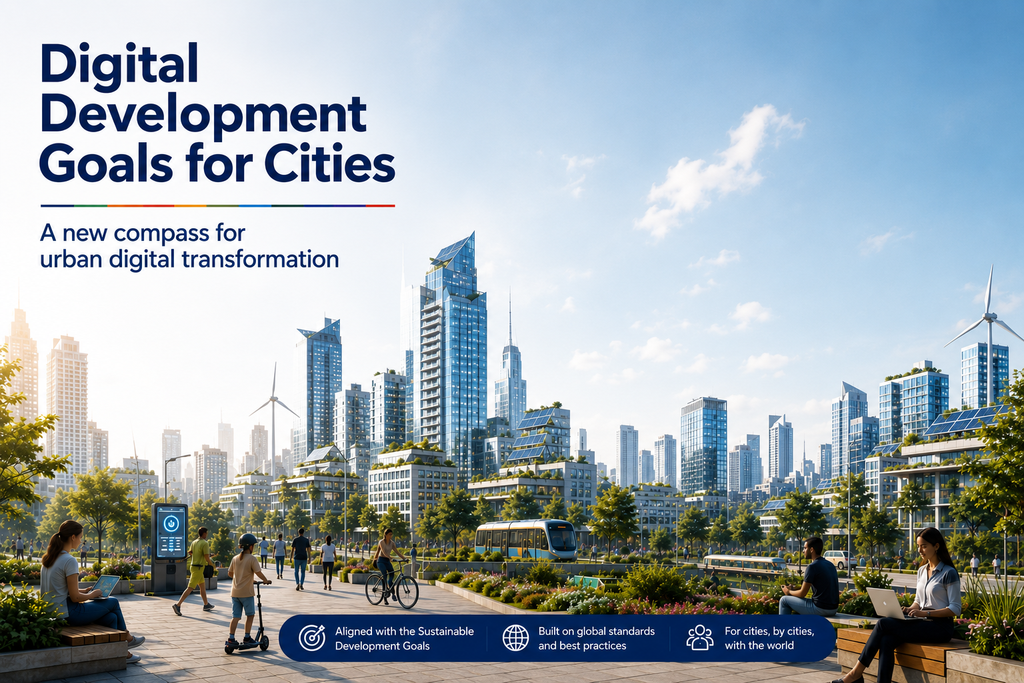
Co-leaders: Bas Boorsma (Urban Innovators Global & Thunderbird School of Global Management, The Netherlands) and Teppo Rantanen (Business Tampere)
Under the United for Smart Sustainable Cities (U4SSC) initiative, a Working Group is active and in place, tasked with the creation of Digital Development Goals for Cities (U4SSC Working Group 6 on Digital Development Goals for Cities). The anticipated output is a global framework of DDGs for Cities, an evolving community of city leaders from across all continents that validates, tests, and builds on the DDGs, and a toolbox of instruments to support local implementation and guidance.
Rationale
Digital transformation is reshaping cities faster than most institutions can absorb it. Artificial intelligence, robotics, quantum computing, and virtualization are not distant possibilities — they are already changing how people work, move, connect, and govern themselves. Cities stand at the center of this shift. Yet most are navigating it without a shared compass.
Working Group 6 exists to build that compass — together with the cities that will use it.
From digitization to digitalization
Two decades of smart city projects have taught the world a great deal. Sensors were installed. Dashboards were built. Services went online. But much of that work optimized an old world rather than transforming it. That is digitization: the adoption of digital tools to make existing institutions more efficient.
The Digital Development Goals are built on an evolved premise. Digitalization is not a technology upgrade. It is a transformation of how cities organize power, make decisions, and create value — new social contracts, new decision-making logics, new distributions of agency, enabled by digital means. The shift is social and institutional before it is technical.
A city is an ecosystem, not a municipality
A city is not simply its municipal government. It is an ecosystem of residents, civil society, academia, start-ups, informal networks, and institutions, each holding a piece of the capacity a digital transformation requires. Concentrating that capacity in city hall alone limits what any city can become. Distributing it — deliberately, across the whole ecosystem — is what allows transformation to take root and last.
This reframing matters for accountability as much as for strategy. When digital transformation is treated as a municipal technology program, city governments end up claiming sole ownership of outcomes they cannot deliver alone, and taking sole credit or blame for results that were never theirs alone to produce. Digitalization requires changing the rules of the game, not just the tools — and that demands a different kind of political will, different partnerships, and different measures of success.
Development outcomes as the starting point
The Digital Development Goals are not a technology roadmap. They are an accountability structure: a shared vision, developed with cities rather than for them, of what a city commits to become for its people. Every capacity a city builds — governance and ethics, knowledge and learning, technology and data, finance and resources, participation and co-creation, civic technology, digital inclusion, institutional capacity — is justified by reference to those goals, not to adoption metrics.
Cities are the right unit of change for this work. They are agile enough to experiment and embedded enough to remain accountable to the communities they serve. What succeeds in one city will not simply transplant into another — geography, culture, and socio-economic conditions all shape what works. The DDGs are designed to respect that difference rather than flatten it, offering a shared frame within which local realities still determine local paths. This Working Group will develop a global framework of Digital Development Goals for Cities. This global framework would fill the gap and support achieving the SDGs. This framework will help cities to report digital progress using clear metrics.
Organized around four clusters
Working Group 6 is developing the DDGs across four interconnected clusters, each stewarded by practitioners and researchers drawn from across the global urban development community:
- Values, Rights and Governance — digitalization governance, sovereignty, privacy, digital access, and digital inclusion.
- New Societal Outcomes — new skills and types of work, urban resilience and security, and inclusive, sustainable virtual and hybrid (“mashed”) worlds.
- Comprehensive Interoperability — achieving interoperability across technology, regulation, operations, organizations, domains, and industries.
- Digital Technology Itself — shaping the conditions under which technology is developed, from carbon-negative digital infrastructure to responsible design.
A living instrument, built with cities
The DDGs are conceived as a living instrument — one that evolves through city input and real-world application, not a standard handed down and left static. Cities are invited into this process as co-creators from the outset, not as reviewers brought in once the framework is finished. A forthcoming DDG Toolbox will translate the framework into practice through assessment approaches, strategy guidance, and capacity-building tools.
Join the Global Community of Urban Leadership
Mayors, deputy mayors, chief digital officers, and urban innovation leaders are invited to join the Global Community of Urban Leadership for the UN Working Group on Digital Development Goals for Cities. Participation is flexible and impact-driven. Cities that join will:
- Help shape a global framework for urban digital transformation
- Ensure local realities and constraints are reflected in the DDGs
- Engage in a peer network of urban leaders worldwide
- Position their city as a leader and reference point
- Have the option to act as a living lab for pilots, case studies, and innovation
Cities are where digital transformation becomes reality. The Digital Development Goals exist to make sure that reality reflects the people who live it.
Related events:

To access the U4SSC collaboration space — including working documents, meeting schedules, and other resources — please ensure you are subscribed to the U4SSC mailing list.
- If you are already subscribed, you can access the page directly by clicking here.
- If you are not yet subscribed, please follow the step-by-step instructions provided.
This Working Group and its Clusters hold regular e-meetings—join the sessions to stay engaged and contribute.
- WG6 – 03 September 2026, 15:00 – 16:30 hours, Geneva time
- WG6 – 24 September 2026, 15:00 – 16:30 hours, Geneva time
- WG6 – 14 October 2026, 14:00 – 15:30 hours, Geneva time
For any query related to the working group, please contact us at u4ssc@itu.int.
Express your interest by contacting the co-chairs at bas.boorsma@thunderbird.asu.edu and teppo.rantanen@tampere.fi.
Co-leaders
- Bas Boorsma (Thunderbird School of Global Management, Arizona State University · Urban Innovators Global)
- Teppo Rantanen (Business Tampere · Urban Innovators Global)
Global community of urban leadership
- Stephen Goldsmith (Harvard Kennedy School)
DDG Cluster Stewards
- Cluster One — Values, Rights and Governance
- Chenayi Mutambasere
- Ajay Nair
- Cluster Two — New Societal Outcomes
- Shalini Gopalkrishnan
- Mani Dhingra
- Cluster Three — Comprehensive Interoperability
- Gert Hilgers
- Marcela Batista
- Cluster Four — Digital Technology Itself
- Salma Siddiqi
- Bamidele Adebisi
- Melissa Armas